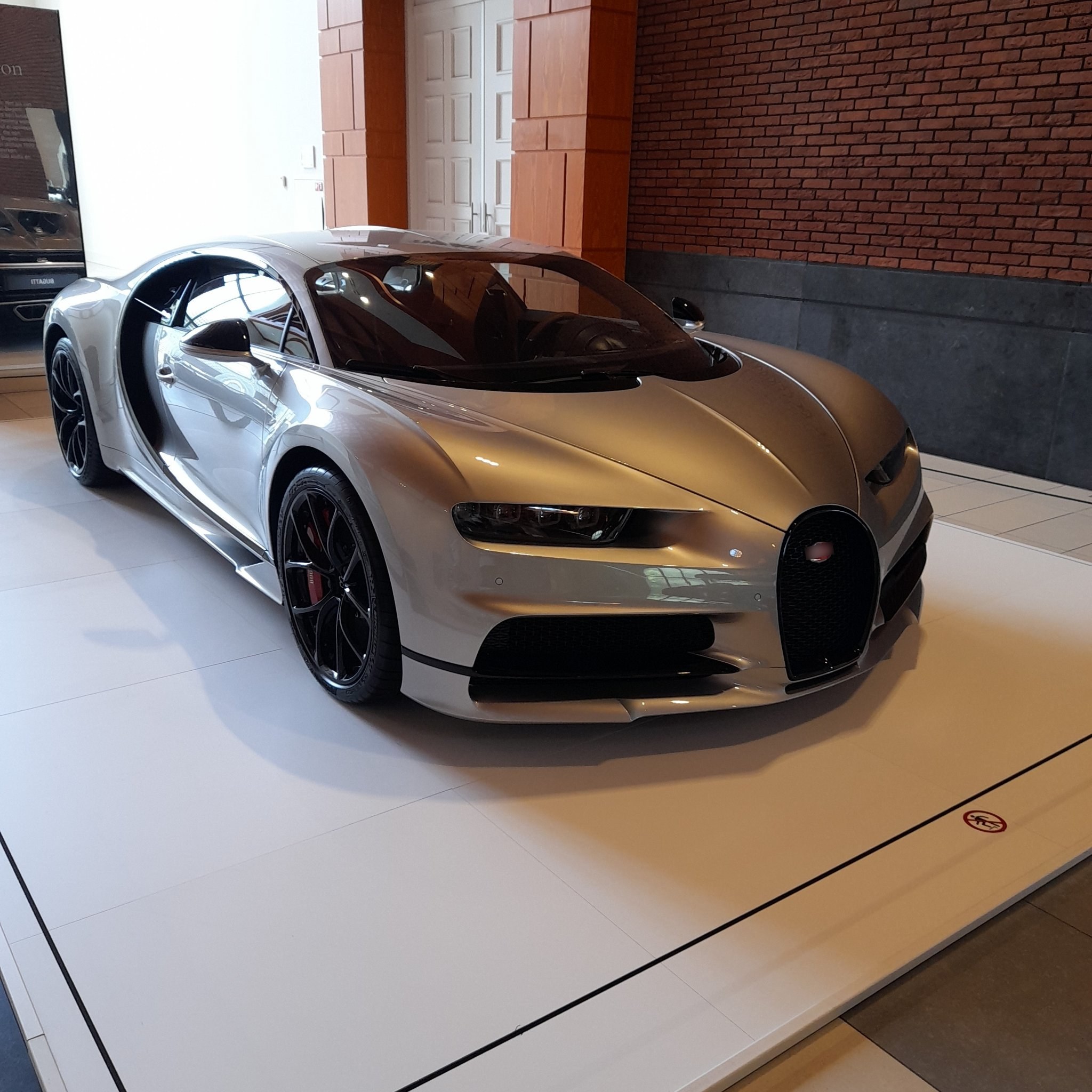
There are rare cars. Then there are cars that make you stop wondering how rare they are and start wondering how one ended up in front of you.
This week's spot is a 2016 Bugatti Chiron, caught by @Thatoneguy — the successor to the Veyron and one of the most extreme production cars ever put on a road.
When Bugatti unveiled the Chiron in 2016, the numbers sounded almost deliberately excessive: 1,500 hp, 1,600 Nm, 420 km/h and a production run limited to just 500 cars. The starting price was €2.4 million before tax.
But the Chiron was never supposed to be just a faster Veyron. Bugatti's brief was essentially to take everything that made the Veyron extraordinary and make it better.
A name from Bugatti's racing history
The Chiron name comes from Louis Chiron, the legendary Monegasque racing driver who competed for Bugatti during the brand's Grand Prix era.
It is a fitting name for a car that sits at the intersection of Bugatti's racing heritage and its modern obsession with outright performance.
The modern Chiron arrived in 2016 as the replacement for the Veyron. Unlike the increasingly complicated world of hypercar naming, Bugatti kept the name simple: one word, one driver, one of the most recognizable cars of the decade.
The W16 refuses to disappear
At the center of the Chiron is an 8.0-litre W16 with four turbochargers.
The engine was heavily redesigned compared with the Veyron's unit. Bugatti targeted 1,500 hp and increased torque to 1,600 Nm, available from 2,000 to 6,000 rpm. Four-wheel drive puts that output onto the road through a seven-speed dual-clutch transmission.
The performance figures are almost absurd even by today's standards.
0–100 km/h takes 2.4 seconds. 0–200 km/h takes 6.1 seconds. 0–300 km/h takes 13.1 seconds.
And the Chiron's road-going top speed is limited to 420 km/h. To unlock it, the driver needs Bugatti's separate Speed Key and a suitable environment.
Keeping 1,500 hp alive
Getting that much power onto the road is one problem. Keeping the engine alive while doing it is another.
The Chiron moves more than 60,000 litres of air per minute through its engine. Its cooling system circulates around 800 litres of water per minute, with a total of ten radiators handling the various cooling duties.
That is one of the details that makes the Chiron different from a simple "big engine, big turbo" hypercar.
Almost every system had to be engineered around the same goal: making 1,500 hp usable in a road car.
The car that broke 300 mph
The Chiron's numbers became even more extraordinary in 2019.
A specially developed Chiron-based prototype reached 490.484 km/h (304.773 mph), making Bugatti the first manufacturer to take a production-based car beyond 300 mph.
That wasn't the standard Chiron's 420 km/h road limit, but it showed just how much margin had been engineered into the platform.
By the time the Chiron era ended, the car had become much more than a successor to the Veyron. It had become Bugatti's statement about what a road car could be when cost, complexity and engineering difficulty were allowed to take a back seat to performance.
The numbers Engine: 8.0-litre quad-turbo W16 Power: 1,500 hp Torque: 1,600 Nm Layout: mid-engine, all-wheel drive Gearbox: 7-speed dual-clutch 0–100 km/h: 2.4 seconds 0–200 km/h: 6.1 seconds 0–300 km/h: 13.1 seconds Top speed: 420 km/h Launched: 2016 Production: 500 cars Price at launch: €2.4 million before tax Built: Molsheim, France A 500-car chapter
Bugatti eventually built exactly 500 Chirons, with the final car completed in 2024.
That last example, a Chiron Super Sport known as L'Ultime, marked the end of an eight-year production run that had produced one of the defining hypercars of the modern era.
That makes seeing one on the road a different experience from seeing an expensive sports car.
There are plenty of cars that cost a fortune.
There are far fewer that combine a 1,500-hp W16, four turbochargers, a 420 km/h top speed and a production run of just 500 examples.
This one is one of them.